We sell solid wood fireplace mantels cut to the length your fireplace needs. Choose a rough-sawn beam, a shelf with the natural live edge on the front, or a floating mantel with no brackets in sight. Every one is sawn from Missouri trees at our mill near Columbia, and you pick it up close to home instead of waiting on a freight truck.
Send us the width of your fireplace opening, the length you'd like and a photo of the wall. We'll reply with a mantel that fits and a price for it.
Three mantel styles
Beam mantels. A solid timber, square or close to it, set across the fireplace like a lintel. Common sizes are 6x8 and 8x8 inches, and the saw marks are often left on. It's the heaviest look and the one that suits stone and brick best. See mantel beams.
Live edge mantels. A thick shelf with the tree's natural edge left on the front face, so the outline of the trunk shows. It works well when the grain and color of the wood are the point. See live edge mantels.
Floating mantels. A mantel with no visible support. It hangs on steel rods or a hidden bracket set into the wall and the back of the beam. A solid floating mantel needs a wall that can carry its weight, which is why some people choose a lighter hollow box instead. See floating mantels.
Not sure which one suits your room? Send a photo of the fireplace with the form, and we'll tell you what we'd put there.
Choose your wood
The species changes the color, the weight and how the mantel takes a finish. Black walnut is dark chocolate brown with a pale cream edge where the sapwood was. White oak is tan, heavy and the current favorite for a clean, modern look. Red oak has a warmer, pinker tone and bold grain. Eastern red cedar is red and cream, full of knots, and light enough to hang without much hardware.
Weight matters more than most people expect. At 12% moisture content, a 6x8 white oak beam weighs about 16 pounds per foot of length, and a 6x8 eastern red cedar beam about 11. We worked those out from USDA Forest Products Laboratory density figures, and our wood species page has the full comparison.
Getting the size right
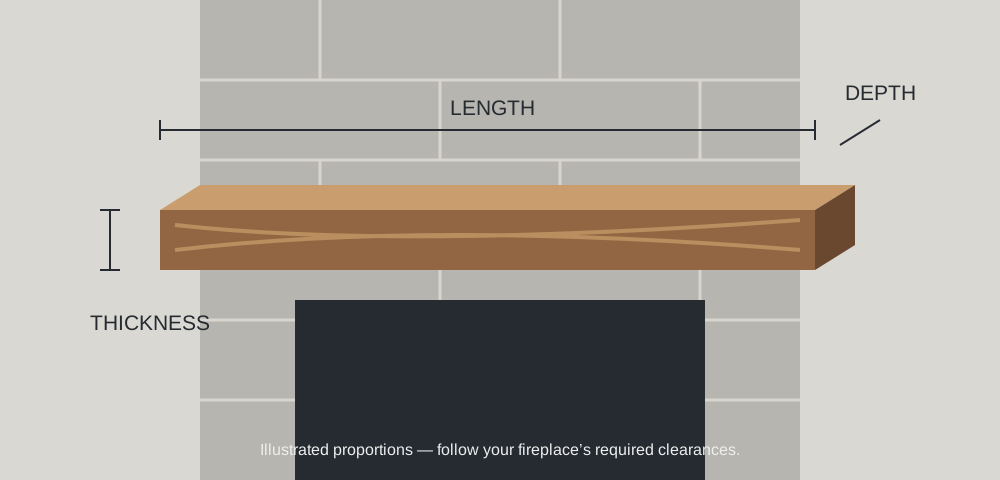
Four numbers decide most mantels: length, depth, thickness and how high it hangs. A mantel usually runs past the fireplace opening on both sides, and its depth and thickness should look right for the size of the wall.
Height is partly a code question. On a masonry fireplace, the International Residential Code keeps combustible trim at least 6 inches from the opening. Closer than 12 inches, it can stick out only 1/8 inch for every inch of distance, about 1½ inches at most, so in practice the bottom of a deep beam sits 12 inches or more above the opening. A gas insert or factory-built firebox has its own clearance chart in the manual, and the local building department decides any question.
Our mantel sizing guide walks through all of it and ends with the five measurements we need from you.
Dry wood matters over a fireplace
A fireplace is the hottest, driest spot in the house, and a solid beam over it keeps drying for months after it's hung. As it dries it shrinks, and a big timber shrinks unevenly, so small cracks called checks open along the faces. In a thick beam that's normal and mostly cosmetic. A beam that's still green when it goes up will move and check much more than one that has had time to dry.
None of our beams are kiln-dried, and every quote says whether the beam is fresh-sawn or air-dried.
For what to expect in the first winter, read Will a solid wood mantel crack?
How ordering works
- Measure. Opening width, the width of the wall or surround, the height of the opening, the length you'd like, and what the wall is made of.
- Send it with a photo. Use the quote form. A photo of the whole fireplace wall tells us more than any measurement.
- Get a quote. We'll reply with the beam or shelf we'd use, its size, the wood and a price.
- We cut it to length. The piece is cut to the exact length you gave us, not the nearest stock size.
- Pick it up. A mantel rides fine in a pickup bed or on a trailer with a couple of moving blankets.
Mantel prices
A solid wood mantel is priced mainly by its length, its cross-section, the species and how much finishing it gets. Nationally, a rough-sawn solid beam costs roughly $15 to $40 a foot, and a planed, finished one roughly $40 to $100 or more a foot. For a finished solid mantel 5 or 6 feet long, $250 to $700 is typical. All of these are national ranges, not our prices.
At those rates, a 6-foot rough-sawn beam would come to about $90 to $240 before any finishing or hardware.
Our pricing page breaks down what moves the price, compares solid wood with store-bought mantels, and has an estimator you can try.
Get a Mantel Quote
Tell us the size of your fireplace and the look you want, and we'll send back a mantel cut to fit and a price.